


| Steve Boniface Memorial Congress | ||||||||
| No |
Venue |
Winner | Games | Online Viewer | Crosstables | Report/Photos | ||
| 13th | 2019 ( BGS ) Fide Open 21-23rd Jun | 1st Alan Merry 4.5/5 | 105 | PGN | CBV | Viewer | Crosstables | Photos BOG ( Feb congress ) Alan Merry (IM) |
| 12th | 2018 ( BGS ) Fide Open 24-26th Aug | 1st Graham Moore 5/5 | 98 | PGN | CBV | Viewer | Crosstables | Graham Moore |
| 11th | 2017 ( BGS ) Fide Open 25-27th Aug | 1st Koby Kalavannan 4.5/5 | 63 | PGN | CBV | Viewer | Crosstables | Report |
| 10th | 2016 ( BGS ) Fide Open 26-28th Aug | 1st Chris Beaumont 4.5/5 | 36 | PGN | CBV | Viewer | Crosstables | |
| 9th | 2015 ( BGS ) Fide Open 21-23rd Aug | 1st Carl Bicknell 5/5 | 68 | PGN | CBV | Viewer | Crosstables | Photos( bog not found ) Report |
| 8th | 2014 Open ( Holiday Inn ) 6-8th Jun | 1st Chris Beaumont 4.5/5 | 58 | PGN | CBV | Viewer | Results | |
| 7th | 2013 Open ( Holiday Inn ) 7-9th Jun | 1st David Buckley, Lewis Martin 4/5 | 63 | PGN | CBV | Viewer | Crosstables | Photos David Buckley |
| 6th | 2012 Open ( Filton Sports ) 25-27th Aug | 1st Jim Burnett 4.5/6 | 20 | https://rating.englishchess.org.uk/events/list-games-swiss?event_code=1437057895§ion_no=1 | ||||
| 5th | 2011 Open ( Filton Sports ) 26-28th Aug | 1st Richard Jones 4/5 | 44 | PGN | CBV | Viewer | Prizewinners Richard Jones | |
| 4th | 2010 Open ( Filton Sports ) 20-22nd Aug | 1st Chris Beaumont 4/5 | 38 | PGN | CBV | Viewer | Photos | |
| 4th | 2010 Major ( Filton Sports ) 20-22nd Aug | 1st Jim Boyce 4/5 | 42 | PGN | CBV | Viewer | Jim Boyce | |
| 3rd | 2009 Open ( Clifton College ) 14-16th Aug | 1st Jim Sherwin | 64 | PGN | CBV | Viewer | Crosstables | Jim Sherwin (IM) Report & Photos |
| 2nd | 2008 Open ( Jurys Hotel ) 11-13th Jul | 1st Chris Beaumont | 54 | PGN | CBV | Viewer | Chris Beaumont (IM) Report | |
| 1st | 2007 Centenary Open ( Thistle Hotel ) | 1st Keith Arkell | 41 | PGN | CBV | Viewer | Keith Arkell (GM) | |
| 1st | 2007 Centenary Major ( Thistle Hotel ) | 1st= Roger Greatorex / K Brameld | 75 | PGN | CBV | Viewer | ||




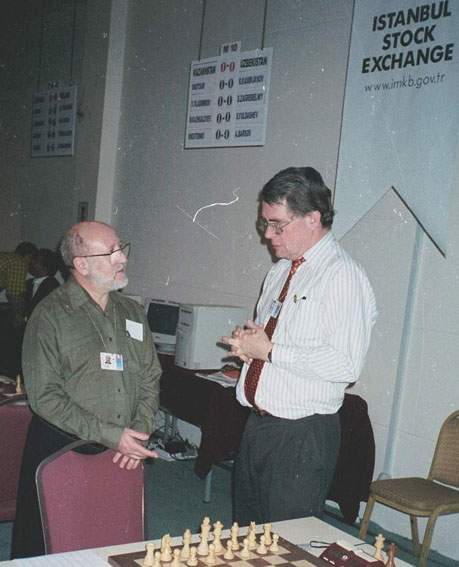
Stephen R Boniface (1951-2005)
Steve came to Bristol in the early 90's, or so I'm told, but it seems like he had been around for a lot longer because he did so much. He was everywhere, organising and controlling a huge number of events. Steve soon realised there were not enough arbiters in the West Country and so he set about changing this. I was one of the many people Steve trained and got through the exam. Once he had sorted out Bristol and the West he turned his attention to other parts of the country and must be responsible for a considerable number of the the new arbiters in the last fifteen years.
He also threw himself into the Bristol-Hannover Exchange: organising visits of teams of chess players from one city to another. He, and his Hannover alter-ego Frank Palm, revitalised the Exchange and I took part in a number of these annual events. Steve and Frank were tireless in organising, though they were like chalk and cheese: Frank ever the anarchist who would leave things until the last moment and Steve being the meticulous planner. I think Steve despaired of Frank on a number of occasions but there was genuine friendship there. On one occasion, Steve bought a subscription to Private Eye for Frank as he knew how much he enjoyed it.

Steve had other good friends in Hannover, including Bernd and Gabi Watermann. One day last year, he phoned me to ask if I would help him book a trip to Hannover on the Internet as he was going to stay with the Watermanns. He wanted the cheapest route, regardless of complexity. Eventually, we settled on a train and two buses to Bournemouth Airport, flight to Frankfurt Hahn on Ryanair, a one hour train ride to Frankfurt central station, with just a fifteen minute gap to pick up the last train to Hannover arriving about half past midnight. The total length of the trip was about sixteen hours with some very tight connections but this did not worry Steve. When he returned I asked him how the trip went. It was fine, he said, but he was very miffed that Bournemouth Airport security had confiscated his umbrella.
For somebody who used to work in IT support, Steve had a very practical attitude to computers. He saw them as a tool, nothing more. He never really took to email and was concerned that his address might end up known too widely and he would get swamped with trivia. On using computers for pairing tournaments, Steve accepted that there were advantages in speed but believed that software would never generate as good pairings as could be done manually. He would ask, for example, whether a program could ever cope with avoiding pairing two people from the same club who had just driven over 200 miles dead. He was playing for Civil Service against Horfield C - this was another piece of typical Steve, he knew Civil Service were short of players so he had moved clubs to help out. We chatted about this and that: I told him my cat had died and he said he was sorry because he'd really liked Jake and how was Anne taking it? I offered him a lift home if he could wait till my match was over but, no, he had to go and dashed off for the bus. You never realise when it's the last time you'll see someone.
One story shows, I think, why he was such a good arbiter. One year at Paignton, one of his favourite events, Steve had the evening off while the other controllers organised a blitz tournament at the playing hall. On his way back from the pub (almost certainly one that was in the CAMRA Good pub Guide) he could not resist dropping in at the hall to see how things were going. One of the controllers came running up: "We're glad you're here, Steve. There's been a dispute - could you sort it?" A boy of about ten was playing a man in his late seventies and the boy was winning easily. He got a pawn to the eighth rank and announced a queen, but not finding a queen to hand he left the pawn in situ. When on his next move he attempted to move his pawn as a queen the man claimed a win for an illegal move (they were playing the blitz rule that illegal moves lose). Steve knew the final round was being delayed and the man was adamant that he must have the win; the small boy was looking very confused. Having checked that the result would not make any difference to any prize money, Steve came up with a quick and unique solution. He took the man off to one side and informed him that he had won the game. He then did exactly the same thing with the young lad. One point each: truly a modern judgment of Solomon! John Richards
by Wilf Arnold
Stephen R Boniface (1951 - 2005)
The sudden and unexpected death of Steve Boniface, aged 54, the west country's best-known chess organiser, was announced this week.
Born and raised in Northampton, while still at school he started playing at the White Melville Club in the town. He came to the west country in 1970 when he took up a three year teacher training course at Rolle College, Exmouth. The fact that the local chess club met in the College made it easy for him to get quickly and fully immersed in Devon chess. Although completing the course, he didn't take up teaching but became interested in the then new world of computers, which later became his career.
He remained in the Exmouth area throughout the '70s, a time when the weekend congress became an established feature of the British chess scene. He played in them and quickly became interested in their organisation. His first organised event was the Exmouth Primary Schools Chess Congress in 1976, which he organised with fellow club member, Bob Jones. It was immediately clear that this was his metier, and he soon moved on to larger, adult events.
In 1980, he left the county to become a computer maintenance operator with a large insurance company in Brighton. But he regularly returned to the west as he became controller of long-established and prestigious events at Paignton, Torquay, Exeter and the peripatetic West of England Championship.
His day job took him to Bristol in the early 1990s and with its active chess league he was in his element. His services as a tournament arbiter grew in demand as his talents became increasingly recognised nationwide. Eventually he retired early in 1999 and was free to devote himself fully to chess. Without losing touch with his existing west country events, he became involved in, to mention but a few more, the British Championships, the Guernsey Congress and the 4NCL
In 2000, he devised the formula for a new event, the Royal Beacon Seniors Congress, held next to Rolle College, Exmouth, which he ran for its first five years. At the time, it was Leonard Barden's opinion that this was the first and only event of its kind in the UK.
Eventually, he was awarded the title of International Arbiter by the world's governing body, one of only a handful in the UK. He was also very active in the Chess Arbiters' Association, helping to train many up-and-coming controllers.
Many tributes have been paid to his unstinting work for the chess cause, all of which refer to his warm and convivial personality at chess tournaments, one which could generally defuse potentially difficult situations with a light touch without compromising his position as the man in charge, able to take tough decisions if necessary. Off-duty, he could amuse his colleagues for hours with a fund of stories about the follies and foibles of chess players. He was a well-respected and greatly popular servant to the game, whose loss will be deeply felt by players and fellow organisers for years to come.
He was unmarried and is survived by his brother and two nieces, Kate and Samantha. Our condolences go to his family.
by R H Jones